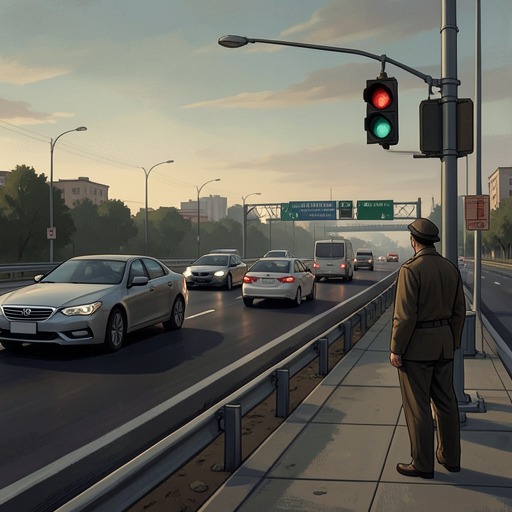
Richmond–San Rafael Bridge
The Wisdom of CrowdsThe Richmond–San Rafael Bridge is a five-and-a-half-mile, two-lane-each-way bridge near San Francisco with no entrance or exit ramps. In a June 2000 experiment there, transportation engineers demonstrated that one vehicle moving slower than the surrounding traffic could trigger congestion well beyond its own position. The bridge serves as a concrete example of how small disturbances can disrupt coordination across a crowded highway.
Setting and experiment
On the morning of June 14, 2000, engineers Carlos Daganzo and Juan Munoz of the Institute of Transportation Studies at Berkeley sent a test vehicle onto the bridge. They instructed its driver to travel significantly slower than traffic, which was moving a little faster than sixty miles an hour despite the late rush hour. The bridge’s uninterrupted two-lane layout in each direction made it possible to observe the effects without entrance or exit ramps complicating the flow.
The change was apparent quickly: vehicles moved between lanes more often, and congestion began to form farther back along the highway, or upstream. Though the bottleneck itself was moving, it still made a substantial dent in traffic flow. The experiment made visible how a small difference in speed could affect vehicles well beyond the slow car.
How a bottleneck spreads
Different lane speeds encourage drivers to change lanes. Those movements make drivers more cautious, and they leave larger gaps between vehicles. The increased spacing can, paradoxically, make further lane changes more likely. The account estimates that each highway lane then carries 10 percent fewer vehicles than it would as a single-lane road.
As roads become crowded, drivers must anticipate one another’s decisions with little more than brake lights and turn signals to communicate. Those signals provide limited information, so anticipation can turn into overreaction: one driver braking too readily can slow an entire highway. Since individual drivers lack a wider picture of traffic, their choices about changing lanes or continuing onward become haphazard. Instead of coordinated movement, the result is stop-and-go congestion.
Significance
The bridge experiment supports the view that traffic jams can arise from small disturbances rather than only from fixed obstructions. It offers a practical illustration of how local decisions interact: a moving bottleneck alters lane speeds, prompts more changes, and contributes to a broader loss of flow. In the book’s account, the bridge becomes a demonstration site for the fragile coordination on which highway traffic depends.